2025 Numbers

I made some minor changes in 2025, had no major accidents, and it was one of the smoothest years in a long time labor wise. As a result, the net dollars per hour were the highest I’ve seen yet, averaging $22.15/hr. If you want to see the fancy graphs and longer explanations of how I come to that number check back to posts from prior years.

2025 was a decent year weather wise, pretty warm and dry actually. The biggest way we feel this is that when we have good weather, especially dry weather, it takes us less time to do things like preparing beds, planting, weeding, harvesting, etc. We still had a lot of residual weed pressure and some spots that really got away from us, but more than in the past few years we also had labor available and good weather when we needed it to stay more on top of the weeds.

Staying on top of the weeds helps with yields. Fewer weeds and higher yields help make harvesting more efficient. Dry weather tends to make cleaning the produce more efficient. So all of those things seem to have added up this year.

My crew this year was experienced and worked consistently. Sara has been with the farm for a few years now and that makes a difference saving time in how much of an explanation any given task needs. A few years ago we had a great high school student work with us for a couple of summers and this year his younger brother came and worked with us for the summer, and he was just as good as his older brother. I also didn’t do any major travel this year so that helped smooth things out. When I look at the graph of labor hours per month this year compared to the past seven years this year was the smoothest and we were only slightly above the labor budget I had set.

In addition to the weather and labor lining up well this year we went back to year round harvesting, adding the spring season back into the mix. That meant more gross revenue than last year when we took the spring off from harvesting. Part of what we were seeing was likely the result of having rested a portion of the beds last year and those beds were relatively weed free and fertile after a year without crops. We put the onions and shallots there, crops that love fertility and are sensitive to weeds, and it definitely helped their yields, and more importantly for us, reduced the amount of time it took to prep, plant, weed and harvest.

Having said all of that, I probably should reduce the net income a bit in the calculations to account for the relative lack of maintenance we did this year, something we’re going to have to address this coming year. This just means that in a sense I expect next year to not look nearly as good on paper as I spend more time and money making needed repairs on equipment and infrastructure. For any of you wanting to get nerdy about how I’ll account for that in the books, think depreciation. I’m currently not using any depreciation expenses and that will change next year.
2024 Numbers

2024 was a better year than 2023, but still not a great year and I’ll try to explain why I think that was in the following paragraphs. If you haven’t read one of these year end posts before, it’s worth going back to earlier years for more complete explanations of how I get the dollars per hour number, but the basic formula is that I take the gross revenue from the farm, subtract non-labor expenses and then divide that by the total number of hours worked on the farm. Ultimately this is the single number that best reflects how successful we are, at least in terms of economic sustainability, and it’s the easiest one to compare from year to year.

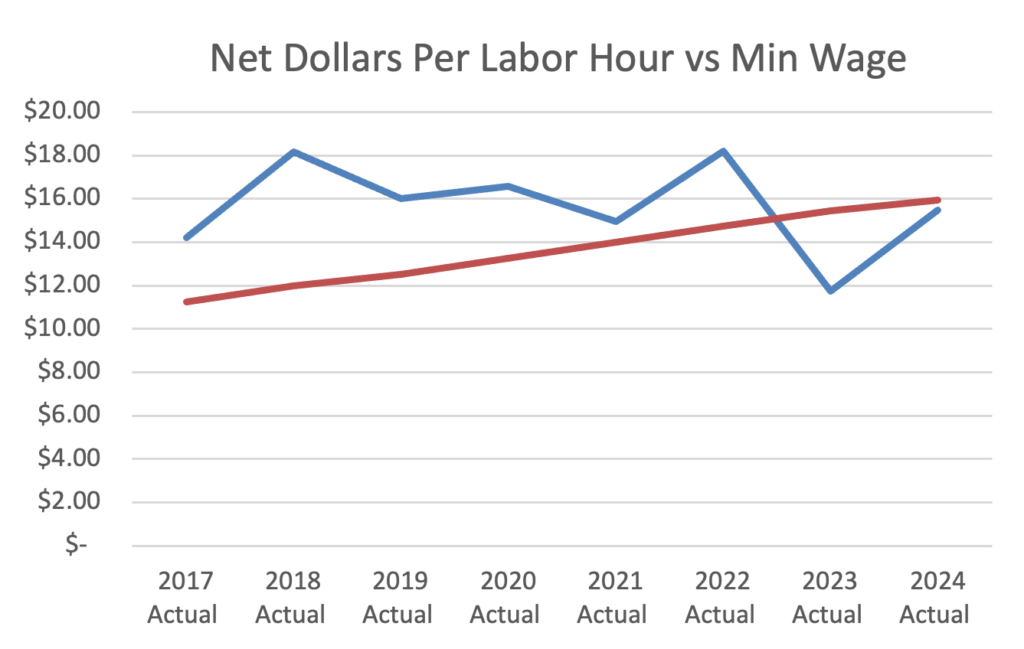
2022 was the highest number we’ve had and then 2023 we hit an all time low and for 2024 the number was back up a little to $15.47/hour. Minimum wage in 2024 for Portland was $15.95/hr, so once again as the owner I made less money, per hour, than anyone else working on the farm. I’d be ok with that if we were all making more, but making less than minimum wage isn’t great. You can see the numbers and trends from 2017 through 2024 in the graph below. The red line is minimum wage which has been rising steadily and the blue line is the net dollars per hour generated.

I talk about why numbers were so low in 2023 in last year’s post. Even though it’s starting to come back up I think there are three big factors in why it’s still low: the farm is shrinking, we took the spring season off from harvest, and I had a fairly serious accident in the spring that set us back a bit.

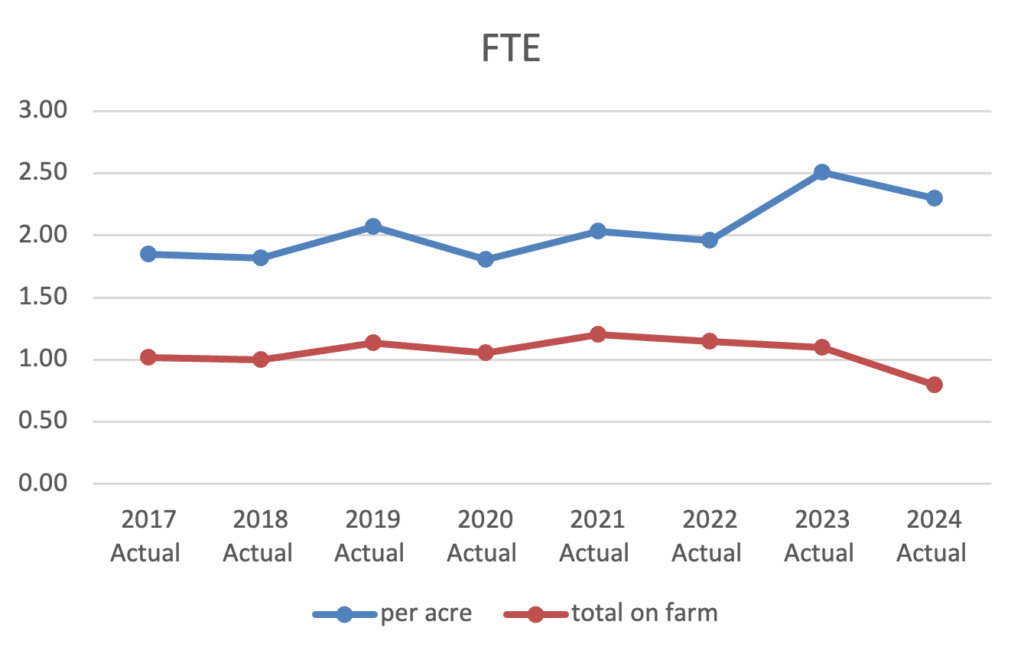
You can see in the graph above that the full time equivalents (FTEs) are still higher, per acre, than they have been historically. Last year this was particularly bad because I screwed up the labor plan, but it’s still high this past year and there are two reasons I see for this. The farm is reducing the amount of space we grow on to make space for Vicolo Farm which is ultimately a good thing, but is tough on our overall budget. Correspondingly we’ve been able to shrink some of the labor, but we have a relatively high fixed labor cost for things like planning and distribution that don’t really shrink as quickly as the production space. This means we have to be more efficient in everything we do. If anything I think I’ve been a little less efficient in the way I’ve been managing my own labor, as well as the crew’s so that’s something to work on for next year.

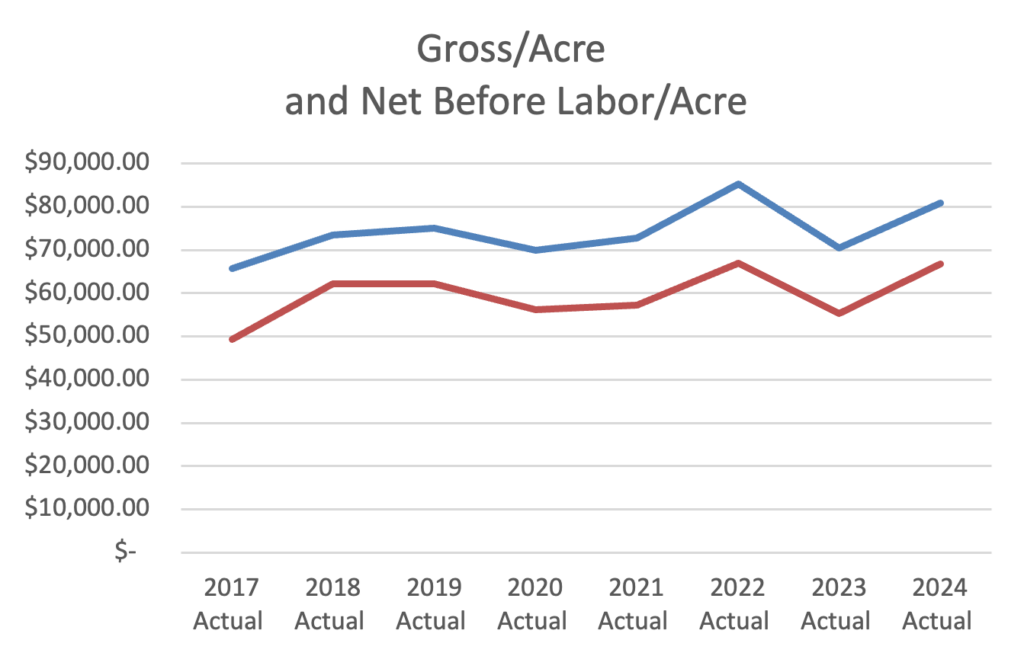
Our gross and net per space are going up after really falling off last year. Realistically these two numbers should be going up as a result of our prices going up at least at the rate of inflation (which is similar to the rate minimum wage is rising). To improve our wages though we actually need to also be more productive in the space, and there is room for that. There are a lot of factors that influence productivity, one of them being our weed pressure, which is closely tied to being able to get field work done in a timely manner. In 2023 we built up a lot of weed pressure for a variety of reasons, some having to do with the weather, some because of labor management issues and other factors. One of the reasons for not doing a spring harvest season in 2024 year was to try to address the added weed pressure proactively. That started out ok, but then I had an accident in May and that definitely set things back, allowing the weeds to get out of hand again. What is it they say about the best laid plans?

As usual, running the numbers confirms a lot of what it felt like this year: progress, but also a continuing need to focus on a lot of the fundamentals.

2023 Numbers, and 2022

It seems that last year I forgot to make my annual blog post summarizing the numbers for the farm’s prior year, so I’ll fix that here and give the update for the last two seasons. Short headline should be that 2023 was by far my worst farming year, financially speaking, ever. Embarrassingly so – but I’m still learning and these blog posts on the numbers are all about sharing to encourage others to run their numbers, learn and share, too, so here we go.

Partly because 2023 was so bad, and partly because I’m in the middle of planning out some changes anyways I spent a little more time with the numbers this year and generated some nice graphs so I’ll share a bit more than I usually do. The last one of these posts was on the 2021 numbers and you can see those by following this link (or just searching for “numbers”) in the search box.

The main number I track from year to year is what is best described as the “net dollars per hour generated” by the farm. Simply, this is the total revenues minus the non-labor expenses, divided by the total number of hours worked by everyone on the farm – including me, the owner. You can go back into the earlier blog posts for more on some of the things that can complicate putting this number together. I think of it as kind of an average hourly wage on the farm across all of the people who work on the farm. 

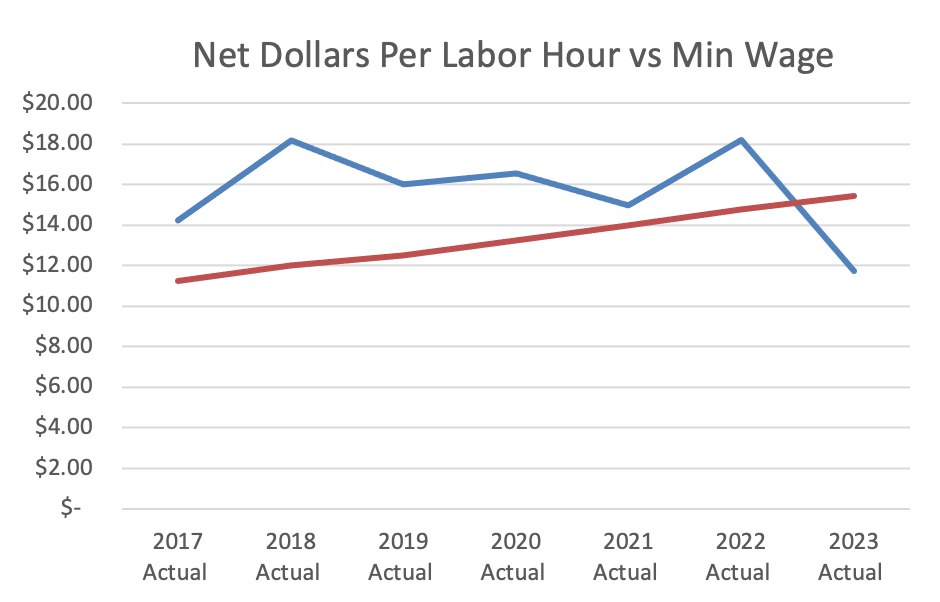
For 2022 the number was $18.19 per hour, which was actually the best number I’ve recorded in past 7 years of tracking at Cully Neighborhood Farm. I had a very similar number  ($18.17) in 2018 and that year I was able to give good bonuses to employees. Because the minimum wage was much higher in 2022 than in 2018, and more employees were above the minimum wage, that didn’t happen last year.

In 2023 the number was $11.74 per hour, well below minimum wage. When that average hourly wage drops below the loaded minimum wage it means that the employees are making more than the owner. By loaded minimum wage I mean minimum wage plus payroll taxes. Minimum wage in Portland was $15.45 this year, and loaded it’s $16.75.

In the graph above you can see that minimum wage in Portland has been rising steadily (the red line) while the net dollars per hour generated by the farm has been less consistent (the blue line). That inconsistency is to be expected to some extent, although ideally it would generally trend upward. Instead it has generally trended flat. Part of this is probably that while minimum wage has been rising steadily at about 5% per year, while our prices haven’t. Labor (including owner labor which most people will record as profit, not labor expense) is consistently about 80% of our total expenses, so it has a bigger impact on our costs than any other factor by far.

In the graph above you can see how closely the gross and net before labor track, which just shows that our non-labor expenses are very consistent. From 2017 to 2021 we were growing a similar number of beds and just harvesting from mid-spring to mid-fall. In 2022 we changed our bed layout which gave us slightly more space and we started harvesting year round. The numbers don’t tell the full story here, but it does seem that may have been good for the income of the farm – part of the reason we did it. In 2023 we gave up about a quarter of the space we had been growing on to let Vicolo farm start up next to us. The impact there was complicated and I’ll talk about that after looking at the next graph, full-time-equivalents per acre versus actual.

Since 2017 we’ve had multiple people employed by the farm, but everyone, including me, works part time. In the graph above I’ve calculated how many people would have been working if they were working full time, and you can see it’s right around one person (the red line). The blue line is that number divided by the amount of space we were cultivating, and it’s very significant that the number jumps in 2023. That is literally why the average hourly wage was so low.

There were a few contributing factors here, but I think the most significant was that I made a mistake in my labor plan for the year, essentially not adjusting our projected labor needs down enough at the beginning of the year to make up for the reduced revenue from growing on less ground.

At the same time a couple other things happened that contributed: one was that I had unexpected turn over in my crew mid-season which meant hiring and training new folks mid-season; another was that I was terrible about limiting my own hours, especially during CSA pick up at the end of the day when I’m the least productive.

There are a number of fixed costs on the farm that don’t shrink even though the production area footprint and gross of the farm has shrunk, and that means we need to be a little more efficient with our labor and other production costs. Unfortunately I was the opposite of more efficient, and because I hadn’t budgeted properly at the beginning of the season I wasn’t getting the signal I should have when I was checking my numbers each month. I could see that we were a little over on labor, when in reality we were quite a bit over on the labor budget. 

Growing conditions for the year, the uncontrollable factor, were also not favorable, and that was compounded by growing conditions the prior year which had contributed significant weed seeds, which in turn increased the weed pressure and need for labor.

I have more thoughts on all of this, but I’m going to wrap up here for now. I will be offering a session on this kind of analysis and the record keeping that allows me to look at these numbers easily at the Oregon Small Farm Conference next month. I have some ideas for changes in 2024 to address the avoidable problems we had in 2023 and I’m also hoping, as I do every year, for favorable weather and lower pest pressure!